
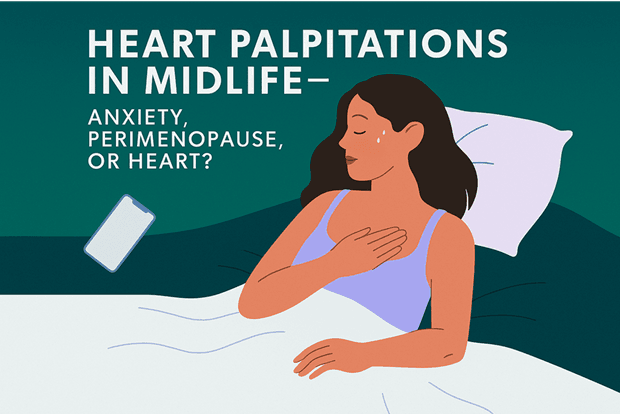
It is a deeply unsettling feeling. You are sitting at your desk or lying in bed when, suddenly, your heart gives a lurch, a flutter, or starts to pound heavily in your chest. It might feel like a missed beat or a frantic racing.
For any woman experiencing this, especially if it is new, the first thought is often a frightening one: “Am I having a heart attack?”
This fear is valid and understandable. Any new heart symptom should be taken seriously. However, for women in their 40s and 50s, the list of potential causes expands. These unnerving palpitations are often not a sign of heart disease, but a classic, physical symptom of perimenopause. They can also be a sign of anxiety—which, confusingly, is also a symptom of perimenopause.
So, how can you tell the difference? And when do you need to seek help?
The truth is, you should not have to guess. This is where precise, expert-led diagnostics are essential. We are pleased to welcome Dr Sonia Dudeja, a highly accredited Menopause Specialist, to the London Diagnostic Centre (LDC). This article, with her expert guidance, will explain the link between your hormones and your heart, and outline the clear diagnostic path available to you.
Why Do Heart Palpitations Happen During Perimenopause?
Perimenopause, the transition before menopause, is defined by hormonal fluctuation. Your oestrogen levels, which have followed a predictable rhythm for decades, suddenly start to surge and crash chaotically.
This hormonal chaos has a direct and powerful effect on your heart.
The Oestrogen-Heart Connection
Oestrogen plays a crucial, protective role in your cardiovascular system. It helps to keep your blood vessels flexible and has a natural, stabilising effect on your heart’s rhythm.
When your oestrogen levels fluctuate, this stability is lost.
- Impact on Heart Rate: Oestrogen interacts with your heart’s electrical system. Sudden drops in oestrogen can cause the heart to become “irritable,” leading to premature beats (the “lurch” or “skipped beat” feeling) or episodes of a fast, racing heart (tachycardia).
- The Adrenaline Link: Oestrogen also helps to manage your body’s response to stress. When oestrogen is low or erratic, you can become much more sensitive to adrenaline. This means a minor daily stressor—or even a hot flush itself—can trigger a full “fight or flight” response, causing a surge of adrenaline that leaves your heart pounding.
This is not “in your head”; it is a physical response to a hormonal change, just like a hot flush.
Differentiating the Cause: A Guide to the Symptoms
The biggest challenge for any woman in midlife is that the symptoms of perimenopause, anxiety, and some heart conditions can feel identical. While only a medical assessment can provide a definitive answer, here are some patterns to look for.
Clues It Might Be Hormonal (Perimenopause)
Hormonal palpitations often travel in a pack. Their link to perimenopause becomes much clearer if you are also experiencing:
- Hot Flushes or Night Sweats: Palpitations very often occur just before or during a hot flush.
- New Anxiety or Mood Swings: You feel a new sense of “free-floating” anxiety or irritability that is not tied to a specific life event.
- Sleep Disruption: You are frequently waking up (often between 3 AM and 5 AM) with a racing heart.
- Other New Symptoms: The palpitations are accompanied by brain fog, fatigue, or new joint pain.
- A Cyclical Pattern: You may notice the palpitations are worse in the days leading up to your period.
Clues It Might Be Anxiety or Stress
Generalised anxiety can also cause palpitations. The key difference is often the trigger.
- Specific Triggers: The palpitations are directly linked to a stressful thought, a work email, or a specific phobia.
- Physical Tension: The racing heart is accompanied by other classic anxiety symptoms like shallow breathing, dizziness, or tense muscles.
- Pattern of Worry: You have a history of anxiety, and this feels like a familiar, if heightened, response.
It is vital to remember that perimenopause causes anxiety. The two are deeply intertwined.
Red Flags: When to Seek Urgent Medical Attention
This is the most important part. While most perimenopausal palpitations are benign, you must never assume. The risk of heart disease does increase for women after menopause, so it is critical to rule out a cardiac cause.
Please seek urgent or emergency medical care (call 999 or go to A&E) if your heart palpitations are accompanied by:
- Pain, pressure, or tightness in your chest
- Pain radiating to your arm, neck, jaw, or back
- Severe shortness of breath or difficulty breathing
- Feeling faint, dizzy, or actually losing consciousness
- Palpitations that do not stop and feel very fast or erratic
The Importance of Not Guessing: Why Diagnostics Are Essential
You cannot and should not self-diagnose a heart symptom. The symptom overlap is too great, and the stakes are too high.
The reassurance you are looking for does not come from a Google search; it comes from a clear, two-pronged approach: a specialist clinical assessment and precise diagnostic testing.
Step 1: The Specialist Consultation
This is where a Menopause Specialist like Dr Sonia Dudeja becomes your essential partner. In an in-depth consultation, she acts as a medical detective. She will listen to your full story—not just about the palpitations, but about your periods, sleep, mood, and family history. This allows her to see the complete hormonal picture and determine the most likely cause.
Step 2: The Diagnostic Tests (The LDC Advantage)
The single greatest benefit of seeing Dr Dudeja at the London Diagnostic Centre is the seamless, integrated care. Based on your consultation, she can refer you immediately for the vital diagnostic tests needed to give you a definitive answer, all under one roof.
These tests are essential to rule out a cardiac problem and identify other mimics:
- ECG (Electrocardiogram): This is a simple, quick test that records your heart’s electrical rhythm in a “snapshot.”
- Holter Monitor (24-hour+ ECG): Because palpitations are brief, an in-clinic ECG might miss them. A Holter monitor is a portable device you wear for 24-72 hours to “catch” the palpitations as they happen during your normal life.
- Blood Tests: This is crucial. Dr Dudeja will arrange a comprehensive blood panel to check for other conditions that cause palpitations, such as an overactive thyroid or anaemia (low iron).
- Echocardiogram: This is an ultrasound of your heart. It allows a specialist to check the physical structure and function of your heart’s chambers and valves.
Your Integrated Patient Journey at London Diagnostic Centre
We have designed this collaboration to give you a clear, efficient, and reassuring path to an answer.
- Book Your Consultation: First, you book your private, in-depth consultation with Dr Sonia Dudeja via her practice, org, selecting the London Diagnostic Centre (LDC) as your location.
- Specialist Assessment: You will meet with Dr Dudeja at LDC. She will conduct her thorough clinical assessment.
- On-Site Diagnostics: She can then refer you directly for your ECG, blood tests, or other necessary scans within the LDC, coordinated for your convenience.
- A Definitive Plan: Once your results are available, you will have a follow-up. If a cardiac issue is ruled out, you finally have the reassurance you need. Dr Dudeja can then create a personalised treatment plan to address the hormonal root cause of your symptoms, which may include modern HRT to restore stability.
Book Your Consultation and Find Clarity
Do not live in a state of fear and uncertainty. Those heart flutters are a signal from your body, and it is a signal that deserves a clear answer.
With Dr Sonia Dudeja now consulting at the London Diagnostic Centre, you have one-stop access to both a leading menopause specialist and the advanced diagnostic facilities you need to safely and accurately manage your midlife health.
To learn more about Dr Dudeja’s specialist services or to book your consultation at the London Diagnostic Centre, please visit her official website: https://mymenopausesupport.org/